

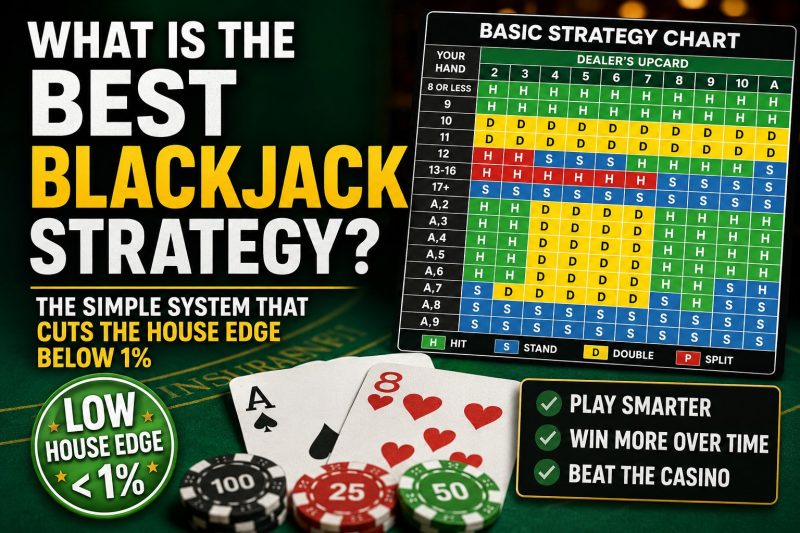
Blackjack is one of the few casino games where players can significantly improve their odds through skill and proper decision-making. Unlike slot machines, where every spin is completely random, blackjack allows players to make choices that affect the outcome of each hand.
So what is the best blackjack strategy? The answer is simple: basic strategy.
Basic strategy is a mathematically proven set of decisions that tells players when to hit, stand, double down, split pairs, or surrender based on their cards and the dealer’s upcard.
When used correctly, basic strategy can reduce the house edge to less than 1% in many blackjack games, making it one of the best bets in the casino.
Featured Snippet: Best Blackjack Strategy Explained
The best blackjack strategy is basic strategy, a mathematically proven system that tells players the optimal play for every possible hand. When used correctly, it can reduce the casino’s advantage to less than 1% in favorable games.
Why Basic Strategy Works
Every blackjack decision has been analyzed using millions of computer simulations.
Researchers calculated the expected value of every possible player hand against every possible dealer upcard. The result is a strategy chart that identifies the play with the highest long-term return.
Basic strategy does not guarantee winning a particular hand. Instead, it minimizes losses and maximizes profits over thousands of hands.
Think of it this way:
- A perfect strategy may lose tonight.
- A poor strategy may win tonight.
- Over time, however, perfect strategy consistently performs better.
Use a Blackjack Basic Strategy Chart
The easiest way to apply basic strategy is by using a blackjack basic strategy chart. These charts display the mathematically correct decision for every possible player hand against every possible dealer upcard. Instead of trying to memorize hundreds of situations, players can simply refer to the chart until the correct plays become second nature.
Basic strategy charts are available for different blackjack variations, including single-deck, double-deck, and six-deck games. Because blackjack rules can vary from casino to casino, it is important to use a chart that matches the rules of the game you are playing. A chart designed for a six-deck game may differ slightly from one designed for a single-deck game.
Many casinos allow players to bring a printed basic strategy card to the table, and dealers generally have no problem with it. In fact, strategy cards are sold in many casino gift shops. Unlike card counting, which some casinos discourage, using a basic strategy chart is completely legal and accepted throughout the gaming industry.
Players who consistently follow a basic strategy chart can reduce the house edge to less than 1% in favorable games. For beginners, no other blackjack skill offers a bigger improvement in long-term results. Before learning advanced techniques such as card counting, mastering a basic strategy chart should be the first goal of every serious blackjack player.
Quick Tip: If you only learn one thing about blackjack, learn a basic strategy chart. It is the single most effective way to reduce the house edge and improve your long-term results.
The Importance of Blackjack Rules
Before discussing strategy, players should understand that blackjack rules vary from casino to casino.
Some rules create a much lower house edge than others.
Look for These Favorable Rules
| Rule | Better for Players? |
|---|---|
| Blackjack Pays 3:2 | Yes |
| Dealer Stands on Soft 17 | Yes |
| Double After Split Allowed | Yes |
| Late Surrender Available | Yes |
| Re-Splitting Pairs Allowed | Yes |
| Fewer Decks | Generally yes |
Avoid These Rules
| Rule | Why It Hurts Players |
|---|---|
| Blackjack Pays 6:5 | When blackjack pays 6:5 instead of the traditional 3:2, the house edge increases by approximately 1.39 percentage points. |
| Dealer Hits Soft 17 | Gives the dealer an advantage |
| Restricted Doubling | Reduces player opportunities |
One of the biggest mistakes beginners make is focusing entirely on strategy while ignoring game rules.
A player using perfect strategy at a 6:5 blackjack table may still face a much higher house edge than a player using average strategy at a good 3:2 table.
Basic Blackjack Strategy Fundamentals
Always Hit Hard 8 or Less
There is no realistic chance of busting with a total of 8 or less. You should always take another card.
Always Stand on Hard 17 or Higher
Once you reach 17 or more, the risk of busting outweighs the benefit of drawing another card.
Double Down on 11
When the dealer shows a weak card, such as a 4, 5 or 6, doubling down on 11 is often one of the most profitable plays in blackjack.
This allows you to increase your wager when you have a strong chance of making a winning hand.
Always Split Aces and Eights
This is one of the most important rules in blackjack strategy.
Always Split Aces
Two aces equal 12, which is a weak hand. Splitting gives you two opportunities to make blackjack or strong totals.
Always Split Eights
A total of 16 is considered one of the worst hands in blackjack. Splitting creates two separate hands starting with 8.
Never Split Tens
A pair of tens equals 20. A total of 20 is one of the strongest hands in blackjack.
Many inexperienced players split tens hoping for two blackjacks, but mathematically this is a losing decision.
The Most Famous Blackjack Decision: 16 Against a Dealer 10
Perhaps no blackjack hand generates more debate than hard 16 against a dealer 10.
Many players hate hitting because they frequently bust. However, basic strategy shows that hitting is usually the correct play.
Why?
Because standing on 16 loses so often against a dealer 10 that hitting actually performs slightly better over the long run.
This demonstrates one of the most important lessons in blackjack:
The correct play is not always the comfortable play.
Understanding Soft Hands
A soft hand contains an ace counted as 11.
Examples include:
- Ace-6, also known as soft 17
- Ace-7, also known as soft 18
- Ace-5, also known as soft 16
Soft hands are valuable because the ace can switch from 11 to 1 if necessary.
This flexibility allows players to be more aggressive.
For example:
- Soft 17 is always a hit.
- Soft 18 may be a hit, stand, or double depending on the dealer’s card.
- Soft 19 always stands.
Common Blackjack Mistakes That Cost Players Money
Taking Insurance
Insurance is often called one of the worst bets in the casino.
When the dealer shows an ace, players may wager that the dealer has blackjack.
Although it sounds appealing, blackjack insurance generally carries a much higher house edge, around 7%, than the base blackjack game.
Most blackjack experts recommend avoiding insurance unless you are counting cards.
Following Hunches
Statements like “the dealer is due,” “I have a feeling,” “this table is hot,” or “the cards are cold” have no mathematical basis.
Successful blackjack strategy relies on probabilities rather than intuition.
Refusing to Hit Stiff Hands
Many players stand on 12, 13, 14, 15, or 16 simply because they fear busting.
Unfortunately, the dealer’s strong upcards often make hitting the mathematically superior choice.
Fear-based decisions generally increase the house edge.
Playing 6:5 Blackjack
Many casinos now offer 6:5 blackjack tables.
This seemingly small change dramatically increases the casino’s advantage. When blackjack pays 6:5 instead of the traditional 3:2, the house edge increases by approximately 1.39 percentage points.
A traditional blackjack pays 3:2.
A $10 blackjack wins:
- $15 at 3:2
- Only $12 at 6:5
That difference adds up quickly over time.
Whenever possible, choose 3:2 blackjack.
Can Card Counting Improve Basic Strategy?
Yes. Card counting can provide an additional advantage beyond basic strategy.
However, card counting is far more difficult than movies and television suggest.
Most successful card counters:
- Master basic strategy first
- Maintain accurate counts
- Adjust bets properly
- Play for long periods
- Accept significant bankroll swings
For the vast majority of casino visitors, learning basic strategy provides the biggest return on effort.
How Much Does Basic Strategy Lower the House Edge?
The exact number depends on the rules.
Typical house edge estimates:
| Game Type | Approximate House Edge |
|---|---|
| Average Slot Machine | 4% to 14% |
| American Roulette | 5.26% |
| Baccarat Banker Bet | 1.06% |
| Blackjack with Poor Strategy | 2% to 4% |
| Blackjack with Basic Strategy | 0.5% to 1% |
This is why blackjack is often considered one of the best casino games for informed players.
Final Thoughts on the Best Blackjack Strategy
The best blackjack strategy is not a secret system, betting progression, or gambling trick. It is basic strategy.
By learning when to hit, stand, split, double down, and surrender, players can reduce the house edge to one of the lowest levels found in a casino.
Equally important is choosing games with favorable rules, particularly tables that pay 3:2 on blackjack.
While no strategy can eliminate the casino’s advantage entirely, basic strategy gives players the best opportunity to maximize their bankroll and make smarter decisions at the blackjack table.
Frequently Asked Questions
What is the best blackjack strategy?
The best blackjack strategy is basic strategy, a mathematically proven set of decisions that tells players the optimal move for every possible hand.
Can blackjack be beaten?
Card counters may achieve a small advantage over the casino under favorable conditions. However, most players should focus on mastering basic strategy.
Should I always split aces?
Yes. Splitting aces is one of the most profitable plays in blackjack.
Should I ever take insurance?
Generally no. Insurance is a poor bet unless you are counting cards.
Is blackjack better than slot machines?
From a mathematical perspective, blackjack generally offers a much lower house edge than most slot machines when played using proper strategy.
Is 6:5 blackjack bad?
Yes. A 6:5 payout significantly increases the house edge compared to traditional 3:2 blackjack. When blackjack pays 6:5 instead of the traditional 3:2, the house edge increases by approximately 1.39 percentage points.
Leave A Comment