

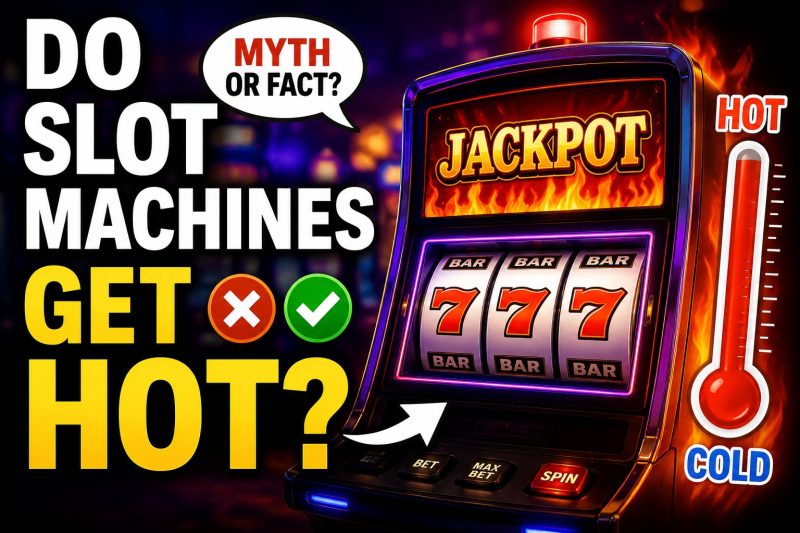
Short answer: No, slot machines do not get “hot” in the way many gamblers believe.
Yet the idea that a slot machine can become hot—or cold—remains one of the most persistent beliefs in casino gambling. Walk through any casino and you will hear players talking about machines that are “ready to hit,” “due for a jackpot,” or “paying out all day.”
But is there any truth to these claims?
The reality is that modern slot machines operate using sophisticated random number generators (RNGs) that make every spin independent of the one before it. Understanding how slots actually work can help players make better decisions and avoid costly misconceptions.
Featured Snippet Answer
Do slot machines get hot? No. Modern slot machines do not become “hot” or “cold.” Every spin is determined by a random number generator, and each result is independent of previous outcomes. A machine that has not paid a jackpot recently is no more likely to hit on the next spin than a machine that just paid one.
What Does “Hot” Mean to Slot Players?
When gamblers say a machine is hot, they usually mean one of two things:
- The machine has recently produced several wins.
- The machine has paid a large jackpot and appears to be paying frequently.
Conversely, a “cold” machine is one that has not paid much money over an extended period.
Many players believe that observing these patterns can help predict future results. They may move from machine to machine searching for one that appears hot or avoid a machine they believe is cold.
The problem is that slot machines do not remember what happened previously.
How Slot Machines Actually Work
Modern slot machines are controlled by computer software and a random number generator.
The RNG continuously produces thousands of random numbers every second, whether someone is playing the machine or not. The instant a player presses the spin button, the RNG selects a number that corresponds to a particular outcome.
This means:
- Each spin is completely independent.
- Previous spins have no effect on future spins.
- The machine does not know whether it recently paid a jackpot.
- The machine does not know how much money you have lost.
- The machine cannot become “due” for a win.
From a mathematical perspective, every spin starts with a clean slate.
Why Players Think Machines Get Hot
If slot machines are random, why do so many players believe they get hot?
The answer lies in human psychology.
People naturally look for patterns, even when no meaningful pattern exists. This tendency helped humans survive throughout history, but it can lead to incorrect conclusions in games of chance.
Imagine seeing a machine pay three jackpots within an hour. It is easy to assume the machine is hot.
However, that same machine may go hundreds or even thousands of spins without a significant win afterward.
Likewise, a machine that has been quiet for hours can suddenly produce multiple jackpots in a short period.
Random events often create clusters that appear meaningful but are simply normal outcomes of probability.
The Coin Flip Example
A simple coin flip illustrates the concept.
If you flip a coin ten times, you might see:
Heads, Heads, Heads, Heads, Tails, Heads, Heads, Tails, Tails, Heads
Many people would consider four consecutive heads unusual.
Yet the probability of the next flip remains exactly 50% heads and 50% tails.
The coin does not become hot after four heads.
Slot machines work similarly, except the mathematics are much more complex.
A machine that has paid several jackpots recently is not any more likely to pay another jackpot on the next spin.
Can Casinos Turn Machine Payouts Up or Down?
This question often gets confused with the “hot machine” myth.
Casinos can select slot machines with different payback percentages, depending on local regulations and manufacturer options.
For example:
- A machine might be configured with a 90% long-term return.
- Another version of the same game might be configured with a 94% return.
- A different market could offer a 96% return version.
However, these settings are established over extremely long periods of play and are typically regulated by gaming authorities.
One important fact many players do not realize is that higher-denomination slot machines often have higher payback percentages than lower-denomination machines. This has been documented for decades in casino gaming reports from jurisdictions such as Nevada.
While there are always exceptions, casinos have historically been willing to offer better returns on quarter, dollar, $5, and even $25 machines because players betting larger amounts are generally more sensitive to game value and are often more experienced gamblers.
As a result, penny slots—which are among the most popular games on the casino floor—frequently have the lowest payback percentages.
For example, a casino might offer:
- Penny slots with long-term returns of 88% to 91%
- Nickel and quarter slots returning 90% to 94%
- Dollar slots returning 92% to 96%
- High-limit machines returning 95% to 98% or more
These figures vary by casino, jurisdiction, and individual game, but the general trend has been observed consistently across many gaming markets.
Nevada gaming statistics have frequently shown that dollar and higher-denomination machines return several percentage points more to players than penny machines. While a difference of just a few percentage points may not sound significant, it can represent hundreds or even thousands of dollars over a large amount of play.
For example, consider $10,000 in total wagers:
- A machine returning 88% would theoretically keep about $1,200.
- A machine returning 94% would theoretically keep about $600.
- A machine returning 97% would theoretically keep about $300.
Of course, actual results can vary dramatically in the short term because slot outcomes are random. A player can win big on an 88% machine or lose quickly on a 97% machine. The percentages only become meaningful over thousands or millions of spins.
What this means for players is that denomination can matter. A higher-denomination machine is not guaranteed to pay more during your session, but it may offer a better mathematical return over the long run.
Casinos cannot simply press a button and make a machine hot for one player and cold for another.
In regulated jurisdictions, changing payout settings generally requires regulatory approval, software changes, or physical access procedures that cannot be performed on the casino floor in real time. A slot manager cannot watch a player sit down and suddenly lower the payback percentage. Likewise, a machine that has not paid a jackpot in months does not automatically become more generous.
The key takeaway is that casinos can choose from different approved payback settings when a machine is installed, and higher-denomination games often receive more favorable settings. However, once the machine is operating on the casino floor, every spin is still determined by a random number generator, and the machine does not become “hot” or “cold” based on recent results.
What Casino Reports Reveal
Gaming regulators in many jurisdictions publish monthly slot machine statistics.
These reports consistently show that slot machines achieve their expected payback percentages over long periods of time.
However, individual machines can vary dramatically over shorter periods.
For example:
- A machine with a 92% payback percentage might return 150% one week.
- The same machine might return 60% the following week.
- Over millions of spins, it gradually approaches its theoretical return.
This variability is why some players mistakenly believe machines become hot or cold.
In reality, they are simply observing normal short-term fluctuations.
Do Experienced Players Look for Hot Machines?
Some experienced gamblers will tell you they search for machines that are paying.
What many of these players are actually doing is identifying casinos or machine banks that have historically produced favorable results, not predicting future outcomes.
There is an important distinction.
Observing that a bank of machines has been active can be entertaining and may create a positive atmosphere, but it does not change the mathematical odds of the next spin.
Professional gambling analysts generally focus on factors such as:
- Payback percentages.
- Game volatility.
- Player club rewards.
- Promotions.
- Bonus multipliers.
- Progressive jackpot values.
These factors can affect long-term value. Whether a machine appears hot usually cannot.
What Players Should Focus on Instead
Rather than trying to find a hot machine, players may be better served by focusing on elements they can actually control.
- Set a gambling budget before playing.
- Choose games with favorable payback percentages when available.
- Take advantage of player club benefits.
- Understand the volatility of the game.
- Know when to stop playing.
These decisions can have a meaningful impact on the overall gambling experience.
Chasing a machine because it appears hot usually does not.
The Bottom Line
Do slot machines get hot?
The answer is no—not in the way most players mean it.
Modern slot machines use random number generators that make every spin independent of previous outcomes. A machine that just paid a jackpot is not less likely to hit again, and a machine that has not paid in hours is not more likely to produce a win.
The belief in hot and cold machines comes largely from human nature and our tendency to find patterns in random events.
While casinos can choose machines with different long-term payback percentages, they cannot instantly make a machine hot or cold for individual players.
The smartest approach is to understand how slot machines actually work, focus on bankroll management, and enjoy the entertainment value of the game rather than trying to predict random outcomes.
Frequently Asked Questions
Are slot machines ever due for a jackpot?
Most slot machines are not due for a jackpot. Traditional slots and most progressive jackpots use random number generators, meaning each spin is independent and previous outcomes do not affect future results.
However, some progressive games feature a Must-Hit-By Jackpot, which is guaranteed to be awarded before the jackpot meter reaches a predetermined amount. In those specific games, the jackpot becomes increasingly likely to hit as the meter approaches the must-hit-by value. Even then, players cannot know exactly when the jackpot will occur—only that it must be awarded before reaching the displayed maximum amount.
For all other slot machines, a jackpot is never “due,” regardless of how long the machine has gone without paying a major prize.
Can casinos make a slot machine hot?
Not in real time. Payback settings are regulated and generally cannot be changed instantly on the casino floor.
Do machines pay more after someone loses a lot of money?
No. Slot machines do not track individual losses and do not compensate players for previous losing sessions.
Why do some machines seem to hit more often?
Random events naturally create winning streaks and losing streaks. These patterns can appear meaningful even though they occur by chance.
What should players look for instead of hot machines?
Payback percentages, game volatility, casino promotions, player club rewards, and proper bankroll management are far more important factors.
Leave A Comment