

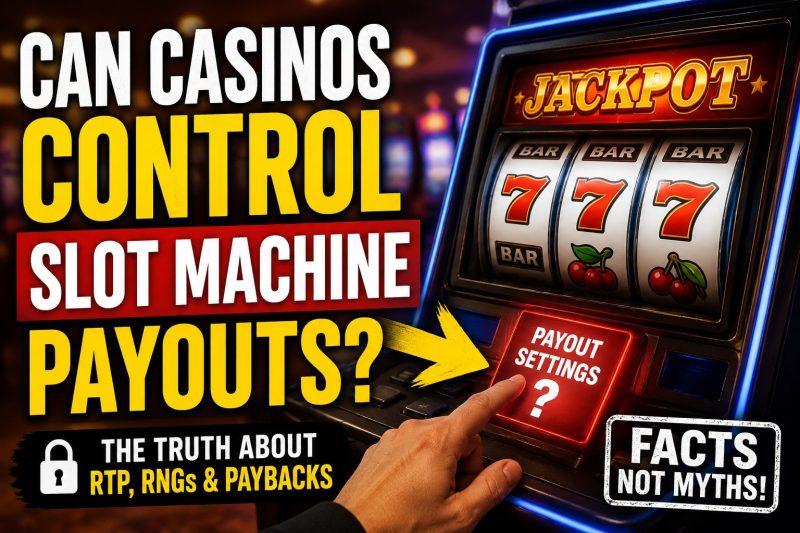
“Can casinos control slot machine payouts” is one of the most common questions asked by slot players, and it is easy to understand why. Players see big jackpots, long losing streaks, “hot” machines, “cold” machines, and different results from games that look almost identical.
Featured Answer: Yes, casinos can control slot machine payouts in the sense that they can choose from approved payout settings when a machine is installed or reconfigured. However, they generally cannot control individual spins, target specific players, or instantly tighten a machine because someone is winning. Modern slot machines use certified random number generators that determine each spin independently.
The key point is this: casinos can influence the long-term payback percentage of a slot machine, but they do not control what happens on your next spin.
The Myth of the Back-Room Button
Many players believe a casino manager can sit in a back room, watch a player win, and press a button to make that slot machine stop paying. That belief has been around for decades, but it is not how regulated casino slot machines work.
Casinos already have a built-in mathematical advantage. They do not need to secretly manipulate individual spins. The house edge is already programmed into the game’s long-term math.
How Slot Machines Actually Work
Modern slot machines use a Random Number Generator, usually called an RNG. The RNG continuously generates numbers, even when nobody is playing the machine.
When you press the spin button, the machine captures a number at that instant. That number determines the outcome of the spin.
- Every spin is independent.
- Previous results do not affect future results.
- A machine is not “due” to hit.
- A jackpot does not make the next spins worse.
- Your player card does not change the outcome.
This is why a machine can appear hot for several minutes, go cold for an hour, and then hit a bonus round. That does not mean the casino changed anything. It is normal short-term randomness.
What RTP Means on a Slot Machine
Slot machine payout percentages are usually discussed using the term RTP, or Return to Player.
RTP is the theoretical percentage of money a slot machine is expected to return over a very long period of time.
| Slot RTP | Expected Long-Term Return | Casino Edge |
|---|---|---|
| 88% | $88 returned per $100 wagered | 12% |
| 90% | $90 returned per $100 wagered | 10% |
| 94% | $94 returned per $100 wagered | 6% |
| 96% | $96 returned per $100 wagered | 4% |
This does not mean you will get $94 back every time you wager $100 on a 94% machine. You may lose your entire bankroll quickly, or you may hit a large jackpot. RTP only becomes meaningful over millions of spins.
Can Casinos Change the Payback Percentage?
Yes. This is where casinos do have control.
Slot manufacturers often offer the same game in multiple approved payout versions. A casino may be able to choose one version that returns 88%, another that returns 90%, another that returns 92%, and another that returns 94%.
Important Player Point: Two slot machines can look exactly the same on the casino floor but have different long-term payback percentages.
The graphics may be identical. The bonus round may look identical. The jackpot display may look identical. But behind the scenes, the math can be different.
Example: Same Slot Game, Different Payback
Here is a simplified example of how this works.
| Game Version | Theoretical RTP | What the Player Sees |
|---|---|---|
| Version A | 88% | Same game, same graphics |
| Version B | 90% | Same game, same graphics |
| Version C | 92% | Same game, same graphics |
| Version D | 94% | Same game, same graphics |
A casino in a competitive market may choose a higher-paying version. A casino with less competition may choose a lower-paying version. The player usually has no easy way to tell which version is installed.
Can Casinos Tighten Machines Before a Busy Weekend?
This is another common belief among slot players. Many people think casinos loosen machines during slow periods and tighten them on weekends or holidays.
In theory, casinos can change approved payout settings when machines are properly reconfigured. In practice, changing large numbers of machines is not usually as simple as flipping a switch.
Depending on the jurisdiction and equipment, payout changes may require secure access, documentation, regulatory procedures, and audit trails. Casinos also do not need to constantly change payouts to make money. The math already favors the house.
A casino with thousands of slot machines and millions of dollars in coin-in can make substantial revenue by simply letting the games operate according to their approved settings.
Can Casinos Target Winners Through Player Cards?
No credible evidence supports the idea that casinos use player cards to punish winners or reduce individual payouts.
Player cards are used for tracking play, awarding points, issuing free play, sending offers, and calculating comps. They are marketing and rewards tools.
The RNG inside the slot machine does not decide outcomes based on whether you are using a card, whether you are a new player, or whether you won last week.
Why Penny Slots Usually Pay Less
One practical point many slot players do not realize is that denomination often matters.
While casinos rarely publish the payback percentage of individual machines, gaming regulators in several states release reports showing the average returns of slot machines by denomination. Those reports consistently show that penny slots tend to have lower payback percentages than higher-denomination games.
For example, Nevada gaming statistics have frequently shown average returns similar to the following:
| Slot Denomination | Typical Average RTP Range |
|---|---|
| Penny Slots | 87% – 91% |
| Nickel Slots | 90% – 93% |
| Quarter Slots | 92% – 95% |
| Dollar Slots | 93% – 96% |
| $5 and Higher | 94% – 98%+ |
To understand what this means, consider two players who each wager $1,000 through a machine.
- An 88% penny slot would theoretically return about $880, resulting in an expected loss of $120.
- A 95% dollar slot would theoretically return about $950, resulting in an expected loss of only $50.
That does not guarantee either player will experience those exact results during a single session. One player may hit a jackpot and walk away a winner, while the other may lose quickly. However, over thousands of hours of play, the higher-payback machine gives players more value for every dollar wagered.
So why do penny slots often have lower returns?
The answer is simple: popularity.
Penny slots are the most heavily played machines in most casinos. They offer entertaining bonus rounds, large progressive jackpots, colorful themes, and low minimum bets. Because demand is high, casinos can generally offer lower payback percentages and still keep the machines busy.
Higher-denomination machines, particularly those in high-limit rooms, often attract more experienced gamblers who understand payback percentages and are willing to move their action elsewhere if the games are not competitive. As a result, casinos frequently offer better returns on higher-denomination slots.
This does not mean every penny slot is a bad game or every dollar slot is a great game. Individual machine settings vary by casino, manufacturer, and market competition. However, if two machines offer a similar experience, the higher-denomination machine will often provide the better long-term value.
Player Tip: Many experienced gamblers, with a large enough gambling budget, would rather play a quality dollar machine returning 95% than a penny slot returning 88%. The difference may not seem large, but over thousands of dollars in wagering, those extra percentage points can significantly extend a bankroll.
This is one reason experienced gamblers often pay attention to denomination, game type, and market competition when choosing where to play.
Why Video Poker Is Different
Slot machine payback percentages are usually hidden from players. Video poker is different because the pay table is visible on the screen.
If you know how to read a video poker pay table, you can often identify whether a game is strong or weak before you play. That is a major advantage over regular slot machines.
Player Tip: Slots usually hide the exact payback percentage. Video poker shows the pay table, which allows knowledgeable players to estimate the game’s return before putting money in the machine.
What Players Should Actually Look For
You cannot control the outcome of a slot spin, but you can make better decisions about where and how you play.
- Play in competitive casino markets when possible.
- Understand that penny slots often have lower paybacks.
- Do not chase “due” machines.
- Do not assume a player card changes your odds.
- Use casino rewards programs for comps, not because they improve payouts.
- Consider learning video poker if you want more visible information about a game’s return.
- Set a gambling budget before you play.
Bottom Line
So, can casinos control slot machine payouts? Yes, but only in a limited and regulated way.
Casinos can choose approved payout settings that determine a machine’s long-term return. What they generally cannot do is control individual spins, instantly tighten a machine while you are playing, or target specific players because they are winning.
The real reason casinos make money from slot machines is not secret manipulation. It is math. The games are designed with a built-in house edge, and over enough play, that edge produces casino profit.
For players, the best approach is to understand RTP, randomness, volatility, denomination, and casino competition. That knowledge will not guarantee a win, but it can help you avoid common myths and make smarter gambling decisions.
Frequently Asked Questions
Can casinos control slot machine payouts?
Yes. Casinos can choose from approved payout settings when a slot machine is installed or reconfigured, but they generally cannot control individual spins.
Can a casino tighten a slot machine while I am playing?
In regulated casinos, payout changes usually require authorized procedures, documentation, and audit trails. It is not as simple as pressing a secret button.
Do slot machines become due to hit?
No. Each spin is independent. A long losing streak does not make a jackpot more likely on the next spin.
Does using a player card affect slot payouts?
No. Player cards track play for rewards, comps, and marketing offers. They do not change the RNG outcome of a spin.
Why do some slot machines seem tighter than others?
Some machines have lower RTP settings, higher volatility, or simply experience short-term losing streaks due to randomness.
Are penny slots worse than dollar slots?
Many penny slots have lower long-term payback percentages than higher-denomination machines, although exact returns vary by casino, game, and jurisdiction.
Leave A Comment