

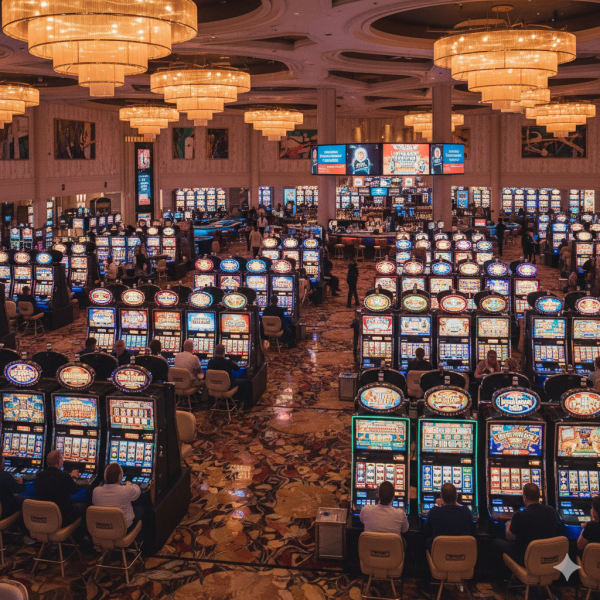
Step onto any casino floor, and one thing becomes immediately apparent: slot machines dominate the landscape. Row after row of colorful, beeping, flashing machines stretch as far as the eye can see, often occupying 70% or more of the gaming space. This isn’t by accident. Slot machines are the single most profitable segment of casino operations, generating more revenue than table games, poker rooms, and sports betting combined in most jurisdictions.
But here’s what seems paradoxical: casinos pay out millions of dollars in jackpots every year. Players win constantly—small amounts, medium payouts, and occasionally life-changing sums. Yet the casinos remain wildly profitable. So how exactly do casinos make money on slots when people are winning all the time?
The answer lies in elegant mathematics, behavioral psychology, and operational efficiency working in perfect harmony. Understanding this system reveals why slots are such a powerful revenue engine for casinos and why the house always wins in the long run, even while individual players walk away as winners.
The House Edge: The Foundation of Casino Profits
At the core of every slot machine’s profitability is a concept called the house edge, expressed through its inverse: the Return to Player percentage, or RTP. Every slot machine is programmed with a specific RTP that determines what percentage of all money wagered will be returned to players over time.
A typical slot machine might have an RTP of 92%, meaning that for every $100 wagered through the machine over its lifetime, it will pay back $92 to players in the form of wins. The remaining $8 is the casino’s gross profit—the house edge. That 8% might seem modest, but when multiplied across thousands of machines and millions of spins, it generates enormous revenue.
The mathematics are ironclad. While individual sessions are unpredictable due to variance—you might win big or lose quickly—over millions of spins, the machine will inevitably converge toward its programmed percentage. The law of large numbers ensures this. No matter how many individual winners there are, the collective result always favors the house by precisely the programmed margin.
Different machines carry different house edges. Penny slots often have lower RTPs, sometimes around 88-90%, giving the casino a larger percentage of each dollar wagered. Higher denomination machines—dollars or higher—typically offer better RTPs of 94-96% or even higher. This isn’t generosity; it’s business strategy. High rollers gambling significant amounts deserve better odds to keep them playing, while casual players on penny slots are less sensitive to the theoretical return.
Volume: The Real Money Maker
Understanding the house edge explains how casinos profit on average, but understanding volume explains why slots are so extraordinarily lucrative. The profit comes not from any single player or session, but from the sheer number of bets placed across all machines continuously.
Consider a modest-sized casino with 1,000 slot machines. If each machine averages just $200 in wagers per day (a conservative estimate), that’s $200,000 in total daily handle. With an average house edge of 8%, the casino generates $16,000 in gross gaming revenue per day from slots alone—nearly $6 million annually.
But most casinos see far higher volumes. Popular machines might process thousands of dollars per day. During busy periods, machines run nearly continuously. A single machine can generate tens of thousands of spins per month. Each spin, whether it results in a win or loss for the player, contributes to the mathematical certainty of the house edge.

This is why casinos focus intensely on metrics like “time on device” and “spins per hour.” The more spins players make, the more money flows through the machines, and the more the mathematical edge translates into actual revenue. A player who sits for four hours making constant bets generates far more profit for the casino than someone who plays intermittently, even if both lose the same amount.
The Psychology of Persistence
Casinos don’t just rely on mathematics; they leverage human psychology to maximize the time and money players spend on slots. Every design element of a slot machine is engineered to encourage continued play.
Near Misses: Slot machines frequently display outcomes that look almost like wins—two jackpot symbols with the third just barely missing. Research shows these near misses trigger the same neurological responses as actual wins, encouraging players to keep trying. Even though these outcomes are programmed into the RNG just like any other loss, they feel different to players, sustaining hope and motivation.
Small Frequent Wins: Modern slots provide regular small wins that keep players engaged. You might bet $2 and win $1.50, technically a loss but psychologically a reward. The machine celebrates this “win” with sounds and animations, triggering dopamine responses that encourage continued play. Players focus on the frequency of wins rather than their net position.
Losses Disguised as Wins: In multi-line slots, you might bet $5 across 25 lines and win $3 on one or two lines. The machine celebrates with winning sounds and animations, even though you’ve actually lost $2. These “losses disguised as wins” are particularly insidious because they obscure the true rate of loss while providing psychological rewards.
Immersive Experience: Modern video slots feature elaborate graphics, engaging themes, bonus rounds, and storylines that transform gambling into entertainment. Players become absorbed in the experience, losing track of time and money spent. The casino benefits from this engagement through increased play duration.
Variable Rewards: Slot machines operate on what behavioral psychologists call a “variable ratio reinforcement schedule“—the most addictive reward pattern known. You never know when the next win will come, so you keep playing. This is the same mechanism that makes social media scrolling and other habit-forming activities so compelling.
Operational Efficiency
Beyond the mathematical edge and psychological design, slots generate profit through operational efficiency that table games simply cannot match.
Low Labor Costs: A single slot attendant can oversee dozens or even hundreds of machines. Compare this to table games, where you need a dealer for every table serving just a handful of players. The labor cost per dollar of revenue is dramatically lower for slots.
24/7 Operation: Slot machines never need breaks, never call in sick, and never go home. They operate continuously, generating revenue every hour of every day. Even at 3 a.m. when table games might be closed, slots are available for the insomniacs and night owls.
Minimal Training Required: Players need no instruction to play slots. You insert money, press a button, and see what happens. This accessibility means more people play more frequently compared to games like poker or craps that require learning complex rules and strategies.
Scalability: Adding more slots to a casino floor is straightforward. You need space and power, but no additional staff training or complicated logistics. This scalability allows casinos to maximize revenue per square foot.
Progressive Jackpots: The Illusion of Generosity
Those enormous progressive jackpots advertised throughout the casino—sometimes reaching tens of millions of dollars—seem like evidence that casinos give away fortunes. In reality, progressives are brilliant marketing tools that increase profitability.
Progressive machines take a small percentage of each wager and add it to the jackpot pool. The casino programs a base RTP for the regular game, then adds the progressive contribution on top. From the player’s perspective, there’s the chance at a life-changing sum. From the casino’s perspective, the progressive draws more players to those machines, increasing overall volume.

The key is that someone has to fund the progressive through their losing bets before anyone can win it. By the time someone hits the multi-million-dollar jackpot, players have collectively wagered far more than that amount into the machines. The casino has already profited handsomely from the handle generated while the progressive grew.
Additionally, the publicity from a major jackpot winner brings more customers into the casino, hoping they might be the next big winner. This increased traffic generates additional revenue across all games. The jackpot winner’s story becomes marketing material that costs the casino nothing beyond the programmed payout.
Volatility Management
Sophisticated casinos understand that while the house edge guarantees long-term profit, short-term variance exists. A casino might have a bad day or even a bad week if several large jackpots hit simultaneously. However, the portfolio effect protects them.
With hundreds or thousands of machines, the aggregate results smooth out variance considerably. While individual machines experience hot and cold streaks, the overall floor performs predictably. It’s like how insurance companies profit despite paying out claims—the law of large numbers works in their favor when dealing with sufficient volume.
Casinos also manage volatility through machine mix. They balance high-volatility machines (bigger jackpots, less frequent wins) with low-volatility options (smaller payouts, more frequent wins). Different players prefer different experiences, and offering variety maximizes the player base while managing risk.
The Reinvestment Cycle
A fascinating aspect of casino profitability from slots is how winners often reinvest their winnings. Studies show that a significant percentage of slot winnings get played back into machines rather than cashed out. This creates a multiplier effect on the house edge.
Imagine a player who wins $500. If they pocket that money and leave, the casino has lost on that session. But if they play that $500 back through the machines, the house edge applies again. Even at a player-friendly 96% RTP, the casino expects to retain $20 from that $500 in subsequent play. If the player wins again and continues playing, the cycle repeats.
This is why casinos offer complimentaries (casino comps)and create comfortable environments that encourage extended stays. The longer players remain in the casino, the more likely their winnings get recycled into additional play, allowing the house edge to work repeatedly on the same money.
Loyalty Programs: Investment in Retention
Casino loyalty programs might seem like they cut into slot profits, but they actually enhance profitability through player retention. By returning a small percentage of theoretical loss as comps, casinos incentivize repeat visits and longer play sessions.
A player earning points toward free hotel stays or meals plays longer and visits more frequently than they otherwise would. The incremental revenue from this additional play far exceeds the cost of the comps provided. Loyalty programs also collect valuable data that helps casinos market more effectively, further increasing profitability.
The psychological impact is significant too. Players feel valued and rewarded, even though the comps represent only a small fraction of their total losses. A player who lost $1,000 but earned a $100 free-play voucher feels like they got something back, improving their overall experience and likelihood of returning.
The Bottom Line
Casinos make money on slots through a sophisticated system that combines mathematical certainty, psychological manipulation, operational efficiency, and smart business practices. The house edge ensures that over sufficient volume, the casino always profits. The sheer number of bets placed across thousands of machines transforms a modest percentage edge into substantial revenue.
The genius of slot machine profitability is that it doesn’t require preventing players from winning. People win all the time, sometimes spectacularly. These wins create excitement, generate publicity, and bring more players into the casino. But the mathematics never lie. For every dollar wagered across all players and all machines over time, the casino keeps its programmed percentage.
Understanding this doesn’t mean you shouldn’t play slots if you enjoy them. Entertainment has value, and gambling can be fun when approached responsibly with money you can afford to lose. But it does mean understanding the reality: the house edge isn’t just a casino advantage—it’s the fundamental business model that makes the entire industry possible. The flashing lights, the celebrating sounds, the occasional jackpot winner—they’re all part of a system engineered with precision to ensure that while individual players might win, the casino always wins in the end.
Leave A Comment