

Whenever you visit a casino it can be a bit overwhelming. You’ll be surrounded by a symphony of spinning reels and chiming jackpots that create an atmosphere of pure chance. Players pull levers, press buttons, and watch symbols align—or not—in sequences that seem utterly unpredictable. But beneath the flashing lights and celebratory sounds lies a more complex question: Are slot machines truly random?
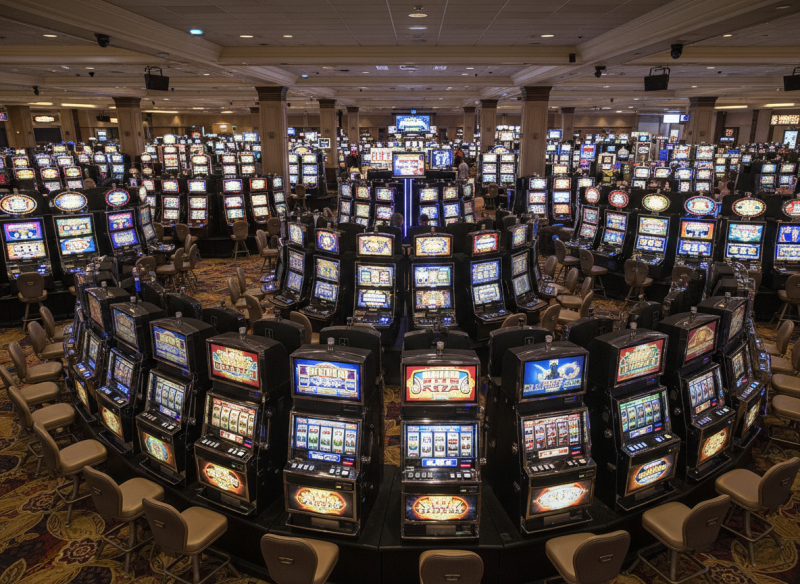
The answer is both simpler and more nuanced than most players realize. Modern slot machines do operate on genuinely random principles, but the randomness is carefully engineered, regulated, and operates within specific mathematical constraints that ensure the house always maintains its edge.
The Heart of the Machine: Random Number Generators
At the core of every modern slot machine sits a Random Number Generator, or RNG. This sophisticated computer program continuously generates numbers at an astonishing rate—typically hundreds or even thousands per second—whether anyone is playing the machine or not. When a player presses the spin button, the RNG doesn’t begin its work at that moment. Instead, it simply captures whatever number it has reached in that exact microsecond.
These numbers correspond to specific positions on the virtual reels. Each number maps to a particular symbol or blank space, determining what appears on the screen. The process happens so quickly that human timing cannot influence the outcome. Whether you press the button a fraction of a second earlier or later makes all the difference, but that difference is entirely beyond human control or perception.

The algorithms used in RNGs are designed to produce sequences that pass rigorous statistical tests for randomness. They’re not truly random in the purest mathematical sense—they’re what’s known as “pseudo-random.” This means they use complex mathematical formulas to generate number sequences that exhibit all the statistical properties of randomness, even though they’re produced by a deterministic process. For practical purposes, especially gambling, these sequences are effectively indistinguishable from true randomness.
Regulatory Oversight and Testing
Slot machine randomness isn’t just a claim made by casinos—it’s a legal requirement enforced by gaming commissions and regulatory bodies. In jurisdictions like Nevada, New Jersey, and most regulated gambling markets worldwide, slot machines must undergo extensive testing before they can be placed on a casino floor.
Independent testing laboratories examine the RNG software to verify that it produces genuinely unpredictable results. These tests check for patterns, biases, or any possibility of manipulation. The machines must demonstrate that each spin is independent of previous spins, that the probability distribution matches the intended design, and that outcomes cannot be predicted or influenced by external factors.
Gaming regulators also require that the RNG software be sealed and tamper-proof. Any modifications to the software must go through re-certification. This regulatory framework exists to protect both players and casinos, ensuring fair play and maintaining public confidence in the gaming industry.
Programmed Randomness Within Designed Parameters
Here’s where understanding slot machines becomes more sophisticated. While each individual spin is random, the overall performance of a slot machine is not left to pure chance. Machines are programmed with a specific Return to Player percentage, commonly known as RTP. This figure, also known as a slot machine payback percentage, typically ranges from 85% to 98%, and represents the theoretical amount the machine will pay back to players over millions of spins.
A machine with a 95% RTP is designed to return $95 for every $100 wagered over the long term. This doesn’t mean you’ll get $95 back if you put in $100 during a single session. In the short term, anything can happen—you might win big or lose quickly. But over hundreds of thousands or millions of spins, the mathematics ensures the machine gravitates toward its programmed percentage.
This is accomplished through the probability distribution built into the RNG’s mapping. The RNG generates random numbers, but those numbers are weighted according to the intended payout structure. Jackpot symbols appear on the virtual reels far less frequently than common symbols. The randomness determines when these rare combinations occur, but the overall frequency is constrained by design.
Think of it like rolling a weighted die. Each roll is unpredictable, but if one face is heavier, it will appear more often over many rolls. Slot machines work similarly, except the weighting is precisely calculated to achieve specific mathematical outcomes.
The Independence of Spins
One of the most important aspects of slot machine randomness is that each spin is completely independent of all previous spins. The machine has no memory of whether it just paid out a jackpot or hasn’t paid anything significant in hours. This principle contradicts many gamblers’ intuitions and superstitions.
Players often believe a machine is “due” to hit after a long losing streak, or that a machine that just paid a jackpot is now “cold.” Both beliefs are false. The probability of hitting a winning combination is identical on every single spin, regardless of history. A machine could theoretically pay two jackpots back-to-back, or go months without a major payout—both scenarios are possible within the bounds of randomness, even if unlikely.

This independence is fundamental to fair gaming. It means no player has an advantage based on when they sit down at a machine, and it eliminates any possibility of timing strategies. The randomness doesn’t owe you anything based on past results.
Physical vs. Digital Reels
Older mechanical slot machines with physical reels operated differently from modern digital machines, though they still aimed for randomness. Mechanical machines used actual reels with a finite number of stops, and the outcomes were determined by where these physical reels landed after being set in motion by a spring mechanism.
Today, even machines that display physical reels are controlled by RNG software. The physical reels are merely for show, stopping at positions determined by the RNG. This allows modern machines to offer much larger jackpots and more complex bonus features than mechanical systems could support, while maintaining true randomness in outcomes.
Video slot machines, which have completely replaced mechanical reels in many casinos, are pure software. The spinning reels you see on screen are animations representing the RNG’s decision, which was made the instant you pressed the button.
The House Edge: Randomness Within Profitability
Casinos don’t need to cheat or compromise randomness to make money from slot machines. The mathematics of the RTP ensures profitability through volume. When thousands of players make millions of spins, the law of large numbers virtually guarantees the casino will see returns matching the programmed percentages.
This is why casinos are comfortable with the occasional large jackpot winner. These big wins are factored into the mathematical model. For every player who wins big, many others will contribute to the house edge through smaller losses. The randomness creates the excitement and possibility that keeps players engaged, while the mathematics ensures long-term profitability.
The Verdict?
So are slot machines truly random? Yes, in every way that matters for practical gambling. Each spin is determined by unpredictable RNG outputs that meet rigorous standards for randomness. No one—not the casino, not the player, not even the machine itself—knows what the next spin will produce.
However, this randomness operates within a carefully constructed mathematical framework designed to ensure specific long-term outcomes. The machines are random in their moment-to-moment operation but deterministic in their overall performance over time. This combination of randomness and mathematical certainty is what makes slot machines both unpredictable and reliably profitable, thrilling for players and sustainable for casinos.
Understanding this duality doesn’t diminish the entertainment value of playing slots, but it does provide a clearer picture of what you’re participating in when you press that spin button. The randomness is real, the excitement is genuine, and the math is always working in the background.
Leave A Comment