

Every night in casinos around the world, players make the same fundamental mistake. They watch a roulette wheel land on black five times in a row and think, “Red is due.” They see a slot machine go cold for hours and believe it’s “about to hit.” They track dice rolls at the craps table, convinced that patterns from the past will predict the future. These players have fallen victim to one of the most pervasive cognitive errors in gambling: the gambler’s fallacy.
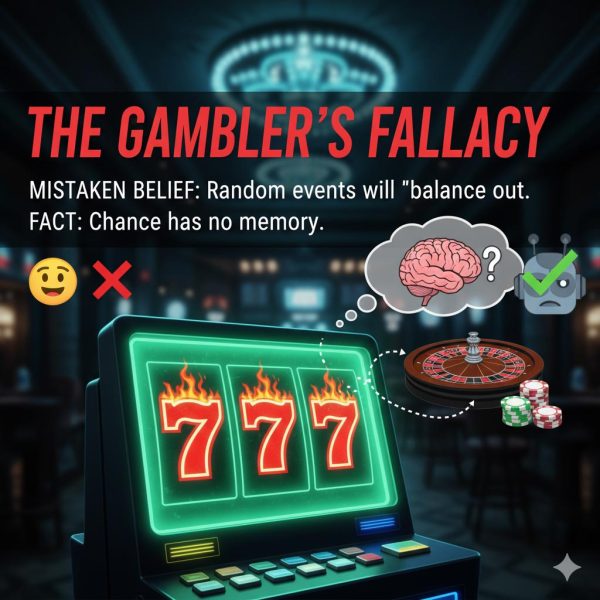
The gambler’s fallacy is the mistaken belief that if something happens more frequently than normal during a given period, it will happen less frequently in the future, or vice versa. It’s the assumption that random events somehow balance out in the short term, that chance has a memory and will “correct” itself to match our expectations of probability. The reality is far less accommodating to hopeful bettors.
Understanding the Fallacy
At its core, the gambler’s fallacy represents a fundamental misunderstanding of how probability works with independent events. An independent event is one where the outcome has no connection to previous outcomes. When you flip a fair coin, the probability of getting heads is always 50%, regardless of what happened on the previous flip, the flip before that, or the previous hundred flips.
The confusion arises because we know that over a very large number of trials, results will approximate the expected probability. If you flip a coin a million times, you’ll get very close to 500,000 heads and 500,000 tails. However, this long-run tendency doesn’t mean that short-term deviations will be quickly corrected. The coin doesn’t “remember” that it landed on heads three times in a row, and it has no mechanism to favor tails on the next flip to restore balance.
Mathematician and philosopher Pierre-Simon Laplace first described this fallacy in the early 19th century, though people had been making the mistake for far longer. The fallacy became particularly famous after an incident at the Monte Carlo Casino in 1913, when a roulette ball fell on black 26 times in a row. As the streak continued, players lost millions betting on red, certain that the extended run of black made red increasingly likely with each spin. They were wrong every time.
The Gambler’s Fallacy at the Roulette Wheel
Roulette provides perhaps the clearest illustration of the gambler’s fallacy in action. A standard roulette wheel has 38 pockets in American casinos: numbers 1 through 36, colored alternately red and black, plus 0 and 00, which are green. Each spin is entirely independent of the last.
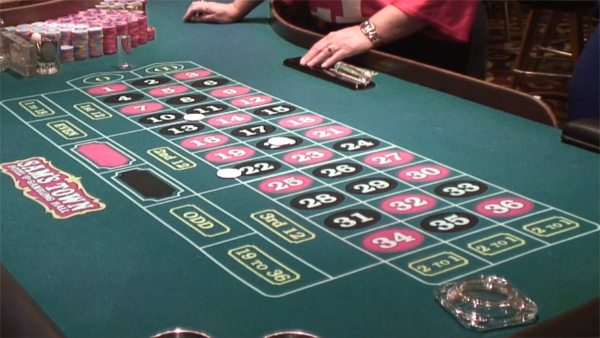
Imagine you’re watching the wheel, and it lands on black seven consecutive times. Many players will start loading up their chips on red, reasoning that red is “overdue.” Some might even calculate that the odds of eight blacks in a row are astronomically small (about 1 in 256 for eight consecutive blacks), and therefore red must be likely on the next spin.
This reasoning contains a subtle but critical error. While it’s true that the probability of seeing eight blacks in a row before any spins occur is indeed very low, once you’ve already observed seven blacks, you’re no longer calculating the probability of eight consecutive blacks. You’re simply calculating the probability of the next spin being black, which is always 18 out of 38, or about 47.4%. The wheel doesn’t know it just landed on black seven times. The previous results have zero influence on the next spin.
Some casinos even display electronic boards showing the last 15 or 20 results, ostensibly to help players spot “trends.” In reality, these boards serve only to encourage the gambler’s fallacy, leading players to make bets based on meaningless patterns.
Slot Machines and the “Due” Jackpot
Slot machines generate another common manifestation of the gambler’s fallacy. Players often believe that a machine that hasn’t paid out in a long time is “due” to hit, or conversely, that a machine that just paid a jackpot has gone “cold” and won’t pay again soon.

Modern slot machines use random number generators (RNGs) that produce results independent of all previous spins. The RNG continuously cycles through thousands of number combinations per second, and the moment you press the button or pull the lever, it stops on whatever number it happens to be generating at that precise instant. This number determines where the reels stop.
Each spin has exactly the same probability of winning as every other spin, regardless of how long it’s been since the last payout. A machine that just paid out a $10,000 jackpot has the same probability of paying out another jackpot on the very next spin as it did on the previous spin. Similarly, a machine that hasn’t paid out in hours isn’t any more likely to hit on the next pull than it was on the first pull of the day.
The belief that machines run in hot or cold streaks is so prevalent that some players even scout casinos looking for machines that “look ready to pay.” They’re chasing an illusion, mistaking random variance for meaningful patterns.
Craps: When Dice Have No Memory
The dice game of craps also falls prey to the gambler’s fallacy. Players might notice that a seven hasn’t appeared in several rolls and start avoiding bets that lose on seven, or they might see a shooter roll multiple passes and assume the “hot streak” will continue.

The probability of rolling any given combination with two dice never changes. The odds of rolling a seven are always 6 in 36, or about 16.7%, because there are six combinations that total seven (1-6, 2-5, 3-4, 4-3, 5-2, 6-1) out of 36 possible combinations. These odds don’t shift based on previous rolls.
What makes craps particularly susceptible to the gambler’s fallacy is the social nature of the game. When a shooter is on a “hot roll,” winning repeatedly, the entire table gets excited and starts increasing bets, assuming the streak will continue. When a shooter “sevens out” after just a few rolls, players might avoid betting on the next shooter, believing that cold streaks also persist. Neither assumption has any basis in probability.
Why We Fall for It
The gambler’s fallacy persists because it aligns with some deeply ingrained intuitions about how the world works. We’re pattern-seeking creatures, evolved to find cause-and-effect relationships. In most areas of life, the past does predict the future. If it’s rained for three days straight, continued rain becomes more likely. If a basketball player has made five shots in a row, they might genuinely be “in the zone” with improved performance.
But casino games are specifically designed to be random and independent. They don’t follow the same rules as basketball shooting or weather patterns. Our pattern-seeking brains haven’t evolved to handle truly random events well, so we impose patterns where none exist.
The Bottom Line
Understanding the gambler’s fallacy won’t make you a winning gambler. Casino games have built-in house edges that ensure the casino profits over time regardless of any betting strategy. However, recognizing this fallacy can help you avoid compounding your losses by chasing imaginary patterns.
The next time you’re in a casino and you feel certain that a particular outcome is “due,” remember: the roulette ball has no memory, the slot machine’s RNG doesn’t care about previous spins, and the dice can’t count how many times they’ve rolled seven. Each event stands alone, independent and indifferent to your expectations.
Chance doesn’t balance out in the short run, and the only sure thing is that over time, the house edge will prevail. The most rational approach? Set a budget for entertainment, enjoy the games for what they are, and never bet money you can’t afford to lose based on the false belief that probability owes you anything.
Leave A Comment