

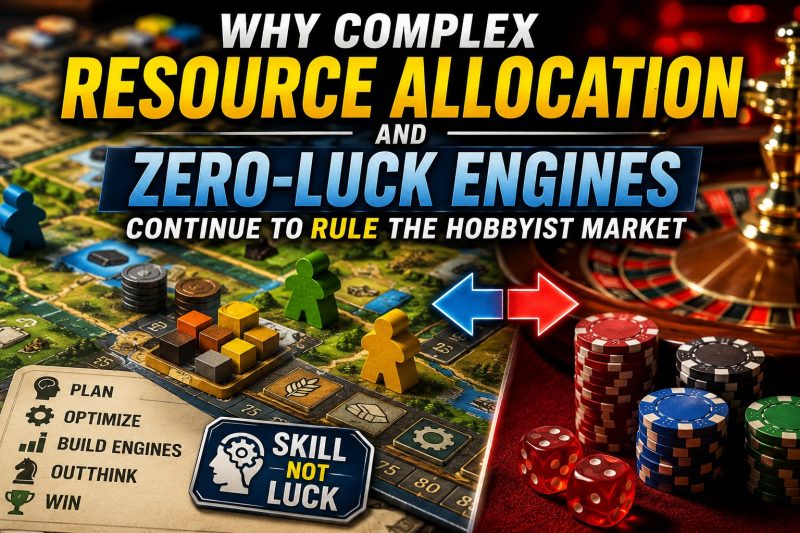
In a hobby crowded with dice, cards, and chaos, the Eurogame stands apart by removing almost all of it. These designs hand victory to the sharpest planner rather than the luckiest roller, rewarding careful resource management over a dramatic turn of fate.
Far from limiting their appeal, that austerity has made Eurogames the backbone of the serious tabletop market for decades. Players who want their decisions to matter keep returning to engines where skill, not chance, decides the winner. Understanding why explains a great deal about what a certain kind of player truly wants from an evening at the table.
What Defines A Eurogame
The Eurogame, named for the German designers who popularized the style, prizes elegant systems over thematic spectacle. Players gather and convert resources, build engines that generate ever more efficiency, and score points through clever optimization rather than direct conflict.
Randomness is minimized or removed entirely, so a defeat can rarely be blamed on bad luck. The result is a contest of pure reasoning, where the board state is fully visible and every player holds the information needed to plan.
That transparency is the genre’s signature and its quiet promise, since doing the math well is reliably rewarded. The best designs reward planning several turns ahead, where a small early advantage compounds into a decisive lead by the final round.
Why Zero Luck Keeps Players Loyal
Not every player wants the same thing, and the tabletop world is wide enough to hold opposite tastes. Where the Eurogame fan savours control and calculation, others are drawn to the rush of an outcome left entirely to chance. The online entertainment world serves that second appetite directly.
The slots and table games at NV casino lean wholly into the thrill of an uncertain result rather than a solved one. Neither preference is wrong, since they simply scratch different itches. The Eurogame proves that some players will always crave a contest of pure skill, while the popularity of chance-based games shows just as many enjoy surrendering to the unknown.
The absence of luck is precisely what binds the dedicated hobbyist. When chance is stripped away, improvement becomes visible and repeatable, so a player who studies the system genuinely gets better and wins more. That sense of mastery is deeply satisfying in a way a coin flip never can be. It also makes the games endlessly replayable, since the challenge lies in solving the puzzle more efficiently each time rather than waiting for fortune to smile.
For a certain mind, a clean engine with no dice is not dry but thrilling, a problem that rewards every hour spent learning its inner workings. Tournaments built around these games can run for hours precisely because the stronger player tends to prevail, rewarding preparation over a hot streak.
Where The Two Worlds Meet
At first glance, a zero-luck Eurogame and a chance-driven casino title look like opposites, one rewarding patience and calculation, the other surrendering the outcome to fortune. Look closer at how each holds a player’s attention, though, and the line between them blurs. Both are built by designers who understand exactly what keeps a person leaning over the table or screen for one more turn, and both reach for the same small set of tools to do it.
The theme and the role of luck may differ completely, yet the underlying machinery of engagement is strikingly familiar. Despite their differences, skill games and chance games share more design DNA than fans of either might admit, and several common threads run through both kinds of play:
- Clear, consistent rules that players can trust to behave the same way every single time.
- A feedback loop that rewards attention, whether through points earned or features triggered.
- Escalating tension as a session builds steadily toward its decisive moment.
- A sense of progress that quietly pulls a player toward just one more round.
These shared hooks explain why a single person can happily enjoy both a four-hour resource-management epic and a quick, chance-driven distraction. The mechanisms differ, but the underlying pull on human attention is remarkably similar. Designers in both fields study the same psychology of reward and anticipation, even as they aim it at completely different kinds of player.
The Enduring Appeal Of The Solved Puzzle
The Eurogame endures because it offers something rare, a contest where effort and intelligence reliably pay off. In a world full of randomness, a game that promises a fair fight decided by skill alone will always find a devoted audience.
The genre’s complexity is not a barrier but the entire attraction for the players who love it. Anyone curious about deeper tabletop design should pick up a well-reviewed Eurogame and sit with its systems for a full evening. The reward is a different kind of fun, one built entirely from thinking rather than luck.
Leave A Comment