

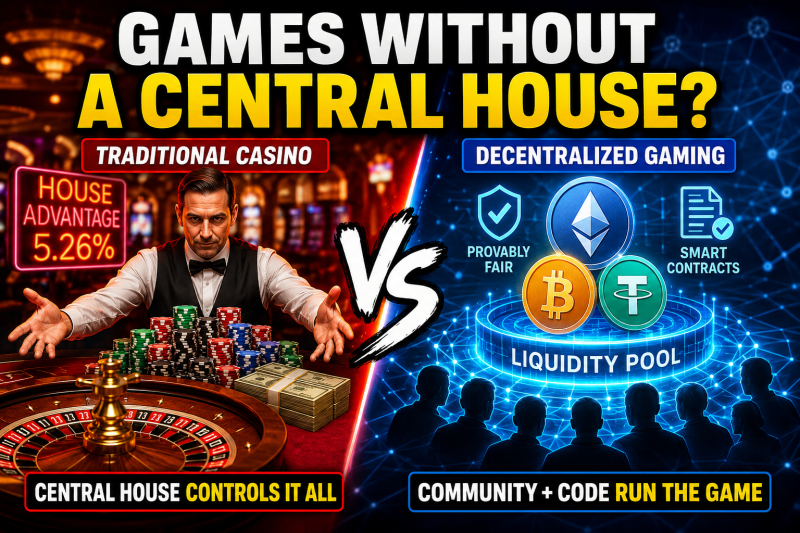
Traditional gambling has always relied on a central operator controlling the bankroll, setting the rules, and collecting a built-in percentage from every bet. Blockchain technology has introduced a fundamentally different structure, one where no single company holds the funds, no operator manages outcomes behind closed doors, and the rules are written in publicly visible code rather than internal policy documents.
How the House Advantage Has Historically Worked
In conventional casinos, the operator is the counterparty to every bet. When players lose, the money goes to the house. When players win, the house pays out from its own reserves. This requires players to trust that a crypto casino or traditional platform is running fair games and will honor withdrawals. That trust is supported by licensing bodies in some jurisdictions, but audits are periodic, and the underlying software remains opaque to players at all times.
The house edge is the mechanism that keeps operators profitable. A 5.26% edge on an American roulette table means the casino expects to retain roughly $5.26 from every $100 wagered over time. The margin is modest per bet, but across millions of wagers, it produces consistent returns for the operator with no requirement for transparency about how those numbers are applied.
The Role of Smart Contracts in Removing the Central Operator
Decentralized gambling platforms replace the operator with smart contracts, which are self-executing programs stored on a blockchain. When a player bets on a web3 casino built this way, the entire process, including the outcome logic and the payout, runs inside the contract automatically. No employee processes the result, and because the contract lives on a public blockchain, anyone can read the code before participating.
Funds used to cover winnings come from liquidity pools rather than a corporate bankroll. Users deposit cryptocurrency into these pools and earn a share of fees or the platform edge in return, effectively acting as the house. A USDT casino using this model distributes both the risk and the returns across many participants rather than concentrating them in a single operator.
Provably Fair Systems and What They Change
Provably fair technology allows players to verify game outcomes independently. Before a bet, the platform commits to a server seed by publishing a cryptographic hash of it. Once the round ends, the original seed is revealed, and the player can confirm the result was fixed before the bet was placed. This makes post-hoc manipulation mathematically impossible, shifting verification from trusting a business to checking a proof.
In a conventional online casino, the random number generator is a proprietary black box. Periodic third-party audits offer some reassurance, but they are snapshots rather than continuous oversight. Provably fair mechanics on a decentralized casino give every player an independent verification tool on every single round, without waiting for an audit cycle.
The Risks That Come With This Model
Decentralized platforms carry their own category of risk. Smart contract vulnerabilities have led to significant fund losses across DeFi protocols, and a DeFi casino is only as secure as the quality of its code and the thoroughness of its audits. Regulatory frameworks have not caught up with this structure, meaning players often have limited formal recourse if something goes wrong outside of a contract exploit.
Token-based governance adds another layer of complexity. Many web3 gambling platforms issue native tokens that grant holders voting rights over platform changes. While this gives players a structural voice that no traditional casino offers, the actual influence depends heavily on how tokens are distributed and whether the community participates actively enough to prevent a small group from controlling decisions.
Where the Model Stands Today
Decentralized gambling removes the central house in a structural sense, replacing institutional trust with auditable code and shared liquidity. The core mechanics are sound, but the gap between what the model promises and what any individual platform actually delivers depends heavily on implementation quality, security practices, and the honesty of the people who built the contracts in the first place.
Adoption is growing, with on-chain data showing billions in deposits flowing into web3 gambling protocols in recent years. The new crypto casino model will not replace traditional platforms overnight, but it has demonstrated that running games without a central house is technically viable, and for players who value transparency and self-custody, that distinction matters more with each passing year.
Leave A Comment