

Finding the best possible odds has always been the primary objective for serious casino players looking to maximize their sessions. For decades, this meant scouting the local casino floor for the loosest slot machines or the blackjack tables with the most player-friendly rules. However, the modern gambling landscape has shifted dramatically over the past few years. Domestic land-based casinos have increasingly tightened their games to maximize corporate profits, leaving veteran players frustrated with diminishing returns.
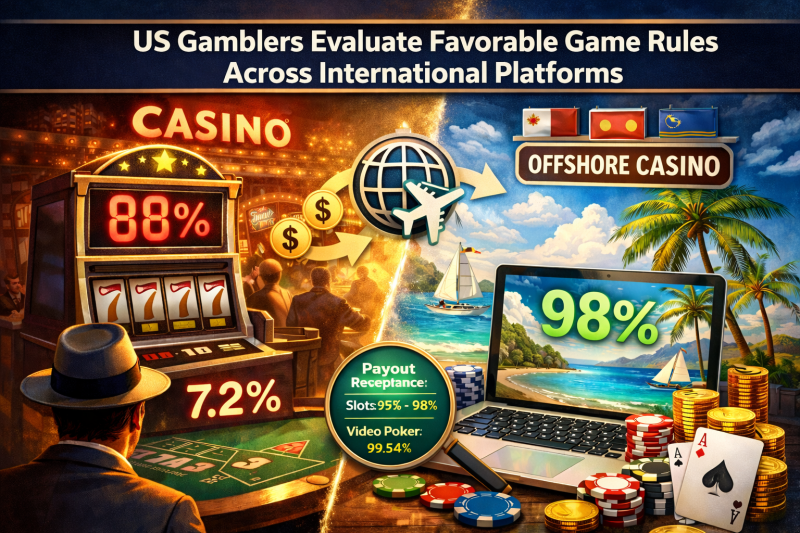
This noticeable squeeze on domestic payouts has prompted a massive migration toward digital alternatives. Savvy gamblers are no longer limiting themselves to properties within driving distance. Instead, they are actively comparing the mathematical advantages of local brick-and-mortar establishments against a growing roster of international offshore casinos explained by CasinoBeats. By expanding their horizons, players can leverage better return-to-player percentages, superior promotional offers, and more favorable baseline rules.
Examining Local Versus International Payout Variations
The most glaring difference between domestic physical casinos and international digital platforms lies in baseline payout percentages. In traditional land-based venues, slot machine returns typically hover between 88 and 93 percent. Nevada slot machine house win percentage averaged 7.2 percent in 2024, representing a slight increase from previous years on massive casino winnings. This tightening of the mathematical edge means players burn through their bankrolls much faster today.
Conversely, international online platforms operate with significantly lower overhead costs, allowing them to offer much higher returns. Digital slots routinely feature return percentages ranging from 95 to 98 percent. Over hundreds of spins, this seemingly small difference translates into extended playtime and a mathematically higher chance of walking away with a profit. Players recognize that travel costs are often better spent directly on games with superior mathematical profiles.
Applying Optimal Video Poker Strategies Online
Video poker remains one of the few casino games where optimal strategy can nearly eliminate the house edge. Unfortunately, full-pay machines like 9/6 Jacks or Better have become incredibly scarce at regional commercial casinos. Property managers know skilled players exploit these favorable rules, so they frequently swap them out for tighter 8/5 or 7/5 variations. This drastically reduces the expected value for even the most mathematically perfect player.
The digital realm offers a refreshing contrast for strategy-focused gamblers. Players who visit online casinos often discover sites offering full-pay video poker variants that have vanished from local floors. Because online operators do not worry about physical floor space, they can afford to host high-return games catering specifically to advantage players. This allows knowledgeable gamblers to execute memorized strategies exactly as intended.
Navigating Licensing Differences In Alternative Markets
Understanding the regulatory environment is crucial when comparing domestic and international gaming options. Within the United States, online gambling is restricted to specific states, limiting competition and allowing local monopolies to dictate game rules. Industry data reveals that US iGaming revenue reached $10.74 billion last year, marking a massive surge as players sought out digital alternatives. Despite this domestic growth, the restricted framework still prevents many players from accessing globally competitive odds.
International platforms operate under entirely different licensing jurisdictions, creating a highly competitive global market. These alternative markets are not bound by the same localized tax burdens or regulatory structures that shape the American casino landscape. As a result, operators compete more aggressively on game selection, payout percentages, and promotional incentives to attract international players. Many platforms licensed in jurisdictions such as Malta or Curaçao rely on third-party testing laboratories to verify the fairness of their games, publishing return-to-player data and certification reports that experienced gamblers often review before committing funds.
This global competition has encouraged players to think more analytically about where they choose to play. Instead of simply selecting the nearest casino or the most recognizable brand, gamblers increasingly evaluate rule variations, payout percentages, and licensing transparency across multiple platforms. For experienced players, these factors can significantly influence long-term results, especially when sessions involve hundreds or thousands of wagers.
Ultimately, the shift toward international comparison reflects a broader transformation in gambling behavior. Information that once required insider knowledge or physical scouting trips is now readily accessible online. Forums, review platforms, and statistical breakdowns allow players to analyze game rules and payout structures in detail before they ever place a bet. In this environment, the most successful gamblers are often those who treat casino games less like pure entertainment and more like a numbers-driven exercise in probability and strategic decision-making.
Leave A Comment