

The End of the Grey Market Illusion
Let’s be real for a second about the 2026 iGaming landscape. The days of exploiting regulatory blind spots are officially dead and buried. State legislatures have realized exactly how much cash is sitting on the table, and they are moving ruthlessly to capture it. The U.S. online casino sector generated over five billion dollars in revenue through May alone. We are looking at an ecosystem on pace to easily crack $12 billion in annual gross gaming revenue this year. That massive surge isn’t just organic growth; it comes directly from a 20 to 25 percent conversion rate of sports bettors crossing over to digital slots and tables. Look closer and you’ll see a massive fracture between the seven elite regulated states and the jurisdictions desperately trying to plug the leaks in their borders.
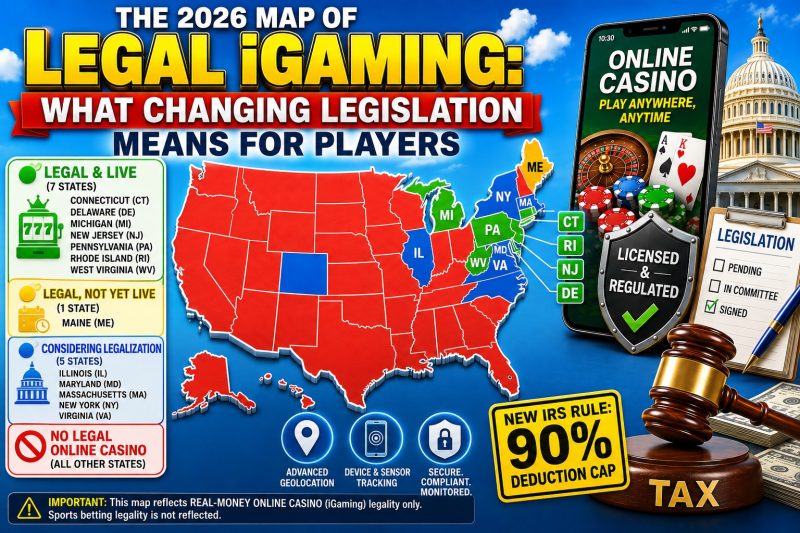
The reality is that the new federal tax code has completely nuked the casual high-volume player. The IRS snuck a catastrophic rule into the 2025 tax reforms that took effect on January 1. They capped gambling loss deductions at a flat 90 percent of total winnings. A player could cycle five million dollars through an account, break completely even for the year—and suddenly face federal taxes on $500,000 of pure phantom income. This brutal math forces anyone with real money on the line to abandon offshore sites with sloppy accounting practices. You absolutely need the pristine, automatic W-2G forms generated by state-licensed operators now just to survive tax season without triggering a catastrophic audit.
The Elite Seven and the Sweepstakes Slaughter
Right now, actual legal certainty exists in exactly seven states: Connecticut, Delaware, Michigan, New Jersey, Pennsylvania, Rhode Island, and West Virginia. Each of these jurisdictions treats the market entirely differently. Delaware handed its online monopoly over to BetRivers late last year. The state instantly quadrupled its revenue, proving that modern software actually matters to the bottom line. Rhode Island aggressively defends its 61 percent slot tax monopoly by suing unregulated prediction markets into oblivion. Meanwhile, the multi-operator bloodbaths in Michigan and Pennsylvania continue to print hundreds of millions monthly due to their immense population density.
Say you touch down at Newark and fire up your phone to play online casino at DraftKings. You are instantly interacting with a heavily audited, hyper-taxed ecosystem. Outside of those specific borders, the situation is getting incredibly hostile for operators and players alike.
Sweepstakes platforms operated for years using a dual-currency loophole to mimic real gambling without the regulatory overhead. That free ride hit a brick wall this year. California’s Assembly Bill 831 went live in January, instantly recategorizing these alternative-means-of-entry models as criminal misdemeanors. Tribal operators pushed this legislation through to protect their $25 billion exclusivity zone and the 112,000 jobs attached to it. The CNIGA and the Yuhaaviatam of San Manuel Nation were not about to let digital startups eat their lunch. The penalties for operators are severe, escalating up to a year in jail for executives who ignore the ban. Illinois followed suit by carpet-bombing the industry with over 60 cease-and-desist letters in February. The legislative message from coast to coast is crystal clear. Pay our state taxes or face criminal prosecution.
Liquidity Pools and The Pennsylvania Poker Catalyst
The silver lining for consumers trapped in this regulated grind is the massive expansion of the Multi-State Internet Gaming Agreement (MSIGA). State-by-state ring-fencing previously choked the life out of digital poker by isolating player pools. You simply cannot run a profitable tournament if you are restricted to a single state’s population limit. Everything changed when Pennsylvania brought its massive player base into the MSIGA network.
Governor Josh Shapiro officially merged the state’s liquidity in April 2025. That single signature unified over 38 million Americans under one digital roof. Smaller shops finally have enough runway to punch up at the heavyweights. You can actually post a massive guarantee on a Sunday major now without taxing the players to death on the buy-in. Look at what BetMGM and PokerStars are doing in this space; they are actively siphoning cross-border traffic to keep their cash games alive around the clock. Shared liquidity remains the last viable weapon for regulated markets. The offshore poker networks are dead men walking.
Server Pings and Barometric Betrayals
The catch? This entire interstate financial machine relies entirely on military-grade surveillance. General consumers still believe these applications just check their IP address to determine location. Frankly, an IP address is practically useless for legal compliance. It offers an accuracy radius of about fifty miles at best. A simple IP check will not save the operator from a catastrophic fine from state regulators if you are standing on the wrong side of the Hudson River.
Modern compliance software aggregates an insane amount of data before your bet slip even registers. Your phone passively scans nearby Wi-Fi routers to triangulate your indoor position down to a ten-meter radius. Outdoors, the system falls back on cell tower ping latency and raw GPS coordinates. The truly invasive part involves your device’s internal hardware suite. Gyroscopes, magnetometers, and barometric sensors are constantly reporting back to the operator’s compliance servers.
Think about the implications of altitude tracking. If your GPS coordinates claim you are sitting in a Denver sports bar, but your phone’s barometer reads sea-level atmospheric pressure, the system flags you for location spoofing immediately. Dynamic buffer zones near state borders will simply block your action entirely rather than risk a federal Interstate Wire Act violation. Even inside physical properties, casinos use Bluetooth Low Energy beacons. These little devices ensure you are actually on the gaming floor and not placing a wager from the parking garage. Advanced Player Account Management systems also scan for Tor exit nodes and active VPNs in the background, neutralizing fraud syndicates before any financial damage occurs.
The Battleground States Looking for a Lifeline
Nobody cares about consumer convenience in 2026. State expansion is purely about covering post-pandemic budget deficits. Maryland is currently ground zero for the East Coast iGaming fight. Senate Bill 885 promises a staggering $1.25 billion in state revenue by 2031 to fund public education initiatives. Retail casino unions are actively trying to kill the bill out of cannibalization fears. Fierce union opposition forced lawmakers to tack on a $10 million employee displacement fund just to get the measure to a November voter referendum.
The Midwestern front isn’t any prettier. Illinois Representative Edgar Gonzalez Jr. resurrected his online casino push with HB 4797, capping taxes at a reasonable 25 percent limit. Yet, the massive Video Gaming Terminal industry is strangling the legislation in committee. Illinois currently hosts nearly 48,700 VGTs across local bars and truck stops, generating $884 million in state tax revenue last year. Those legacy stakeholders will burn the house down before surrendering their localized monopolies to digital upstarts.
New York is playing its usual heavy-handed game. Senator Joseph Addabbo’s latest push demands a 31.5 percent tax rate and mandates that digital operators physically house their servers inside existing retail New York casinos. Albany politicians are intentionally wiping out the sweepstakes guys first. The ultimate goal here is a tightly controlled, state-backed cartel. New York demands an absolute chokehold on digital action; whoever gets caught in the legislative crossfire is just collateral damage.
The Imminent Taxation Trap
The regulatory bloodbath of 2026 leaves the average consumer completely cornered. Clever workarounds are extinct. The dual-currency sweepstakes illusion is effectively dead. Operators have built an inescapable digital fence using your phone’s own altimeter to ensure every dollar wagered is a dollar taxed by the state.
When the IRS’s 90-percent deduction cap finally starts ripping through player bankrolls this tax season, the friction of this highly policed ecosystem will become painfully apparent. We are no longer debating whether digital gambling will be legalized across the country. Make no mistake; we are simply watching a heavily armed bureaucracy figure out exactly how hard they can squeeze the player before the game stops being fun.
Leave A Comment